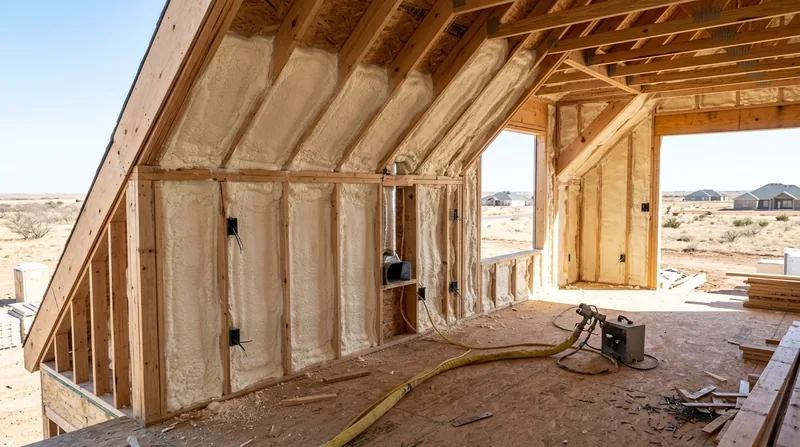




Commercial and new construction spray foam insulation in Amarillo and Canyon lets builders close walls and roof decks with continuous thermal control before drywall seals the frame. Across Potter and Randall counties, new subdivisions, brick ranch replacements, and metal shop projects all benefit from foam applied in the framing stage, when cavities are open and accessible. The high plains climate here swings hard between winter wind-driven cold and summer heat gain through attics, and new construction that starts with proper insulation avoids the energy penalty that plagues mid-century stock. We work alongside builders and contractors to spray walls, roof decks, and rim joists before closure, ensuring no thermal gaps hide behind drywall or metal cladding. Unlike retrofit work, new construction lets us control the substrate, the application sequence, and the cure environment from the start. This section covers how we approach new builds in Amarillo, what methods work best for different frame types, and how to budget for foam in your construction schedule.
Why Commercial and New Construction Spray Foam Matters on the High Plains
New construction in Amarillo and Canyon faces the same thermal challenge as every house on the high plains: wind-driven infiltration in winter and radiant heat gain in summer. When you frame a building on slab-on-grade or pier-and-beam and leave cavities uninsulated, you are betting that drywall alone will stop air leakage. It will not. Spray foam applied during the framing stage creates a continuous air seal at the same time it insulates, eliminating the thermal bridging through wood studs and the infiltration paths that fiberglass cannot close. For metal buildings and commercial shells, foam controls condensation on steel in a way no blanket insulation can match.
- We spray wall cavities before drywall hangs, capturing every stud bay and corner without demolition later.
- Roof decks and sealed attics receive foam before sheathing and roofing go on, ensuring no voids or settling.
- Rim joists and band board areas stay sealed tight against the wind-driven cold that cuts through older construction.
- Metal buildings and barndominiums benefit from closed cell foam that stops condensation on steel and controls moisture year-round.
- New commercial shells can be sprayed to code before tenant fit-out, locking in thermal performance from day one.
Starting with foam in new construction costs less per board foot than retrofitting a closed wall later, and the building performs correctly from its first winter.
Key info: A new subdivision in Palisades or Bushland framed with spray foam walls and a sealed roof deck will outperform the same layout insulated with fiberglass by a measurable margin in winter heating bills and summer cooling load, especially on a windy site where air sealing matters as much as R-value.
For more detail on how air sealing complements insulation, see our air sealing service page.
How We Work with Builders: The New Construction Spray Foam Process in Amarillo
Working with builders in Amarillo means coordinating spray foam application into the construction schedule at the right moment: after framing and rough-in utilities, before drywall and roofing closure. We meet with the builder or general contractor to identify the scope, confirm R-value and thickness specifications, and schedule the spray date. On the day of work, we set up equipment, establish a work perimeter with mechanical ventilation, and spray all designated cavities to the agreed thickness. The foam cures over 24 to 48 hours, and the building can proceed with drywall, roofing, or exterior cladding once cure is complete. For metal buildings and barndominiums, we often work with the metal stud or truss crew to ensure foam fills every cavity and seals all thermal bridges.
- We meet with the builder before framing to discuss R-value, thickness, and which cavities need foam versus which can use alternative insulation.
- We schedule the spray date to fit the construction sequence and weather window, avoiding rain or extreme cold.
- We set up mechanical ventilation during cure and specify a re-entry window of 24 to 48 hours before drywall or roofing proceeds.
- We provide a written estimate with R-value and thickness specifications for every cavity or assembly, so the builder knows exactly what is being installed.
- After cure, the building is ready for the next trade: drywall, metal roofing, exterior finish, or interior fit-out.
Clear communication with the builder and a firm schedule keep new construction projects on track and spray foam on budget.
Example: A new metal shop in Fritch gets sprayed with closed cell foam on all walls and the roof deck. We work with the metal stud contractor to schedule the spray for the day after studs go up and before the metal cladding is fastened. Foam cures in 36 hours, and roofing can proceed on day two. The finished building has no condensation risk on the steel frame, even on cold mornings in January.
For details on the differences between closed cell and open cell foam in new construction, see our closed cell spray foam page.
Spray Foam Methods for New Construction: Closed Cell, Open Cell, and Combination Approaches
| Approach | Description | Best for |
|---|---|---|
| Closed Cell Foam | High-density foam with closed cells, R-value 6 to 7 per inch, vapor barrier properties, moisture resistance, and structural contribution to the frame. | Metal buildings, barndominiums, roof decks, rim joists, and any assembly where condensation control or vapor management is critical. |
| Open Cell Foam | Low-density foam with open cells, R-value 3.5 to 4 per inch, vapor-permeable, lighter, and less expensive than closed cell. | Interior walls, attics with vented assemblies, sound dampening, and new construction where vapor drive is not a concern. |
| Combination (Hybrid) | Closed cell spray on rim joists and rim board, open cell in interior walls above grade, balancing cost and performance. | New residential construction in Amarillo and Canyon where budget and performance both matter, and some cavities need vapor control while others do not. |
| Sealed Roof Deck Assembly | Closed cell foam sprayed on the underside of roof sheathing or metal deck to create a conditioned attic, eliminating attic venting and thermal bridging through rafters. | New commercial buildings, new residential with HVAC or ductwork in the attic, and any project where attic ventilation cannot be guaranteed long-term. |
Commercial and New Construction Spray Foam Cost in Amarillo: What to Expect
The cost of commercial and new construction spray foam in Amarillo depends on the scope of cavities, the type of foam (closed cell or open cell), the thickness required to meet code or performance targets, and site access. A free commercial estimate is the starting point. We measure or count all cavities to be sprayed, confirm the R-value and thickness with the builder or property manager, and provide a written estimate with board-foot totals and cost. Closed cell foam costs more per board foot than open cell, but delivers higher R-value and vapor control. A new residential subdivision with 30 to 50 houses might budget $3,000 to $8,000 per house for wall and rim joist foam, depending on frame type and cavity size. A metal building or commercial shell is quoted on site after we assess the square footage, wall height, and roof assembly.
Factors that affect cost include:
- Foam type: closed cell costs more than open cell but provides higher R-value and moisture resistance.
- Thickness: thicker foam delivers higher R-value and costs proportionally more per cavity.
- Cavity count and complexity: simple rectangular walls cost less per board foot than intricate roof decks or rim assemblies.
- Site access and weather: difficult access or poor weather conditions may delay the spray date and affect scheduling.
- Travel distance: we serve Amarillo, Canyon, Bushland, Hereford, Dumas, Borger, and surrounding areas with no separate mileage charge.
Getting 2 to 3 estimates from qualified contractors is always smart. Compare not just price, but the R-value, thickness, and warranty terms in writing. A low estimate with no specifications or a vague warranty should raise a red flag.
For a detailed pricing overview and examples, visit our pricing page.
What to Look for When Hiring a Spray Foam Contractor Near Amarillo
Hiring the right spray foam insulation contractor for new construction is as important as choosing the right builder. You want a contractor who understands the local climate, communicates with your builder, delivers specifications in writing, and stands behind the work. Ask any contractor for proof of insurance and the registration or licensing that your city or county requires before work begins. Texas regulates contractors at the municipal level, not the state level, so requirements vary by city and county. Contact your local building department or city contractor office to confirm what registration or bonding applies in Amarillo, Canyon, or wherever your project is located.
- Verify that the contractor is fully insured and can provide a current certificate of insurance naming your project or builder as additional insured.
- Ask for a written estimate that specifies the R-value, thickness, and board-foot total for each cavity or assembly.
- Request references from other builders or contractors the company has worked with on new construction in the Panhandle.
- Confirm that the contractor understands local building code and will coordinate with your builder or project manager on scheduling and cure time.
- Ask about the ventilation setup during spray and the re-entry window before drywall or roofing can proceed.
- Verify that any warranty offered is in writing and specifies what is covered, for how long, and who honors it.
A contractor who takes time to understand your project, answers questions clearly, and delivers a firm estimate in writing is the one to hire. If you are building in Amarillo, Canyon, or the surrounding areas and need a spray foam estimate for new construction, contact us for a free commercial estimate.
Commercial & New Construction Spray Foam in Amarillo: Pricing Guide
| Service | Price | Details |
|---|---|---|
| Free commercial estimate | $0 | On-site measurement and scope review with builder or general contractor, written estimate with R-value and thickness specifications |
| Closed cell spray foam (new construction) | Starting at $1.50 to $2.25 per board foot | High-density foam with R-value 6 to 7 per inch, condensation control, and vapor barrier properties for metal buildings and roof decks |
| Open cell spray foam (new construction) | Starting at $0.80 to $1.25 per board foot | Low-density foam with R-value 3.5 to 4 per inch, cost-effective for interior walls and sound dampening in new residential builds |
| Residential new construction (walls and rim joists) | Typically $3,000 to $8,000 per house | Depends on frame type, cavity count, foam type, and thickness; closed cell rim joists with open cell walls is a common hybrid approach |
| Commercial or metal building | On-site estimate | Cost determined by square footage, wall height, roof assembly, and foam type; larger projects benefit from economies of scale |
| Travel and scheduling | Included | No separate mileage fee in Amarillo, Canyon, Bushland, Hereford, Dumas, Borger, and surrounding service areas |
Indicative pricing, the exact cost depends on square footage, finish, and site access. Free personalized estimate within 24h at (806) 639-5022.


